When a customer asks ChatGPT or Google Gemini for a recommendation, does your business appear? LLM SEO tools help you answer that question, see which competitors get mentioned, and find content worth improving.
AI search is growing quickly. The Reuters Institute’s 2026 study found that weekly use of generative AI for finding information increased from 11% in 2024 to 24% in 2025 and 38% in 2026 across the six countries tracked throughout the study. Researching topics, asking for advice, answering factual questions, and finding recommendations were among the most common uses.
This guide compares 10 of the best LLM SEO tools for tracking mentions, analyzing citations, and creating or improving content. You’ll find their core features, strengths, limitations, and pricing to help you choose a tool that fits the work you need to do.
Quick Answer: Which LLM SEO Tool Is Best?
These five LLM SEO tools are useful starting points for different needs:
- Botric: Best for AI visibility tracking, content optimization, and blog generation in one platform.
- Profound: Best for enterprise AI search research and marketing workflows.
- Peec AI: Best for investigating cited sources and competitor visibility.
- Otterly.AI: Best for daily brand mention and citation monitoring.
- Semrush: Best for combining traditional SEO research with AI visibility analysis.
Also consider SE Ranking for agency SEO reporting, AIclicks for citation research and content actions, LLMrefs for keyword-based tracking, AirOps for content production, and Scrunch AI for website diagnostics and AI crawler insights.
What Are LLM SEO Tools?
LLM SEO tools are platforms that help businesses measure and improve their visibility in AI-generated responses from ChatGPT, Gemini, Claude, Perplexity, and other AI search experiences.
Unlike traditional SEO software, which primarily measures keyword rankings, backlinks, organic traffic, and technical website performance, LLM SEO software examines what AI platforms actually say about a brand.
Most tools focus on four areas:
- Brand visibility: Whether AI platforms mention or recommend your business.
- Website citations: Whether AI-generated answers reference pages from your website.
- Competitor analysis: Which competing businesses appear for relevant questions.
- Content opportunities: What information your website may be missing and where improvements could help.
Some platforms specialize in one area. Others combine tracking, analysis, website audits, and content optimization.
AI-generated answers are now a major part of how people use search. In May 2026, Google reported that AI Overviews had more than 2.5 billion monthly active users, making it increasingly important for brands to understand how they appear in AI-generated results.
Below, we compare the best LLM SEO tools based on their features, AI platform coverage, pricing, and capabilities.
Each review covers what the tool does best, its key features, and its cons to help you find the right fit for your needs.
1. Botric

Botric is an LLM SEO tool that combines AI visibility tracking, citation analysis, technical audits, and content generation. It helps you find the questions where your business appears or gets left out, inspect the sources cited in answers, and compare your presence with competitors. It tracks ChatGPT, Google AI Overviews, Perplexity, Claude, and Google Gemini.
The platform also helps you decide what to change. Botric compares AI answers with your Brand Profile to flag missing or inaccurate business information. GEO audits identify content and technical gaps, while Blog Agent and Page Agent help you create articles and improve existing pages. This connects your LLM SEO research with work you can review, publish, and measure over time.
Key Features
- AI visibility tracking: Monitor brand mentions and citations across the supported platforms. Review results by engine to see where your business appears and where it is missing.
- Prompt-Level Tracking: Track the questions people ask across supported AI platforms and see whether your brand was mentioned, cited, or left out. Each prompt also shows the competitors that appeared, visibility changes since the last scan, and its intent, such as commercial, general, or branded.
- Prompt Research: Discover questions related to your topics or test your own branded, comparison, and commercial prompts. Run manual tests to investigate new opportunities between scheduled scans.
- Citation analysis: Inspect the domains and URLs cited in AI answers. Separate citations to your website from third-party sources to identify pages worth improving or researching.
- Competitor analysis: See which competing businesses appear for your target prompts. Use their mentions and cited sources to investigate topics where your own information is incomplete.
- Brand Profile checks: Compare AI-generated answers with your business profile to find inaccurate descriptions, missing details, or misrepresentation of your products and audience. Botric recommends content updates to address these gaps.
- GEO and site audits: Identify content and technical issues that may affect how AI systems access or understand your website. Prioritized recommendations help you decide what to investigate first.
- Blog Agent: Generate articles around relevant topics and unanswered prompts. All three paid plans include unlimited blogs.
- Page Agent: Improve existing website content when important product details or answers are missing. This lets you work on an established page instead of creating a new article for every gap.
- AI traffic analytics: Connect GA4 to examine identifiable AI referral traffic alongside visibility results. This helps distinguish appearing in answers from receiving visits.
- MCP and API Access: Connect Botric with tools such as Claude Code, Claude Desktop, and Cursor through MCP to access your AI visibility, audit, and performance data directly within your existing workflow.
Pros
- Connects visibility tracking with content optimization and generation.
- Includes unlimited blog generation on all three paid tiers.
- Supports manual prompt testing between weekly scheduled runs.
Cons
- Broader engine coverage and MCP/API access require higher plans.
Pricing
- Bit: $15/month. 15 prompts, ChatGPT and Google AI Overviews, 1,500 credits, one site, and unlimited blogs.
- Byte: $49/month. Adds Perplexity, 25 prompts, 5,000 credits, and two admin seats; unlimited blogs included.
- Infinity: $149/month. Adds Claude and Google Gemini, 150 prompts, 15,000 credits, five sites/workspaces, MCP/API, and unlimited blogs.
2. Profound
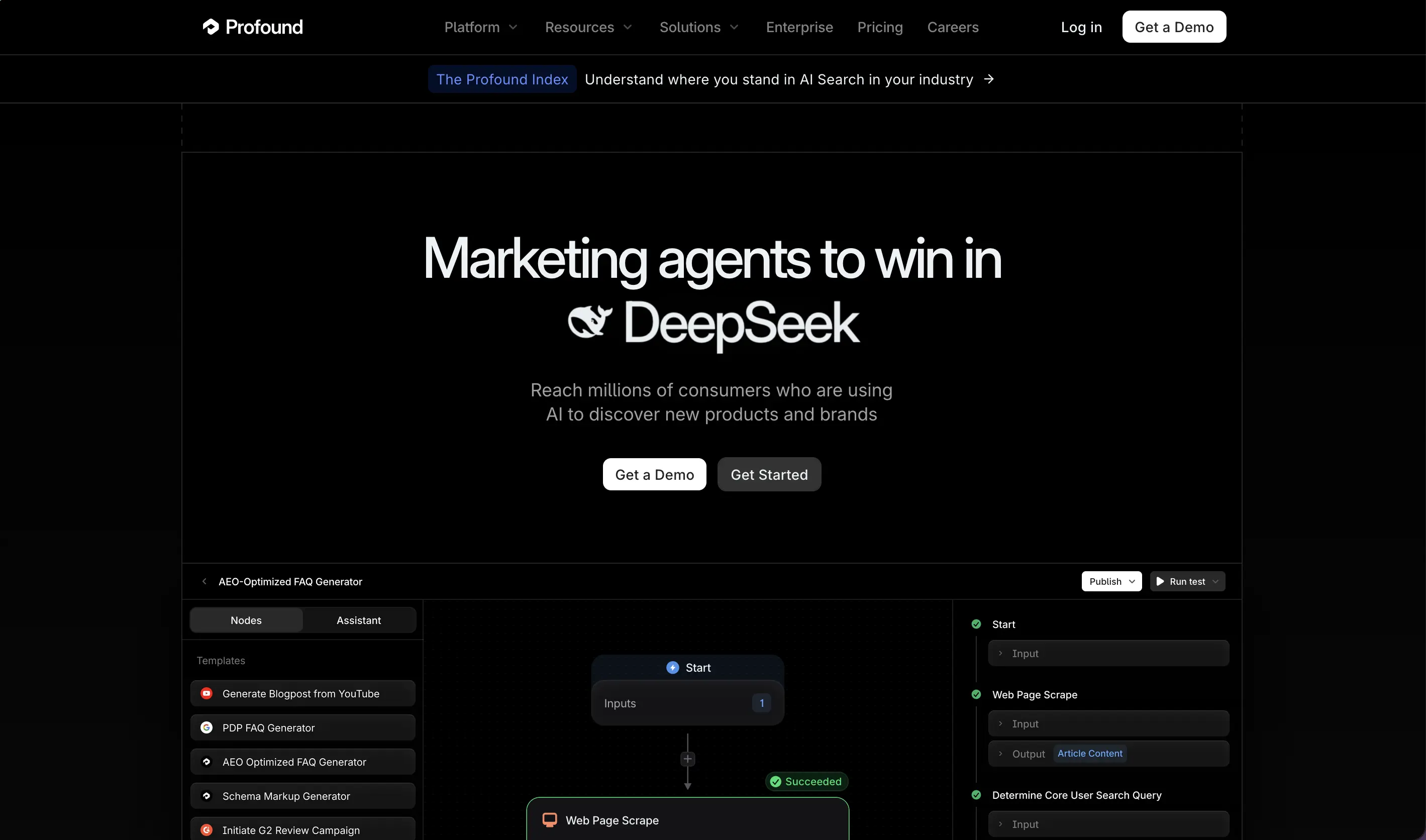
Profound combines research into AI answers with tools for marketing teams to act on that research. Answer Engine Insights examines brand and competitor appearances, Prompt Volumes supports demand research, and Agent Analytics adds information about AI traffic. Its enterprise offering covers multiple answer engines and configurable regional requirements.
It also includes AI Marketer and reusable agents for recurring work. That matters when evaluating it against older descriptions that treat it only as a reporting dashboard. A larger organization can investigate a visibility problem and build an execution workflow around it.
Key Features
- Answer Engine Insights: Track how supported AI platforms mention and describe your brand. Compare results across engines to identify where visibility differs.
- Citation research: Investigate the pages referenced in AI answers. Use source patterns to guide content updates and research into third-party coverage.
- Prompt Volumes: Research demand for questions asked in answer engines. Use this information to prioritize topics beyond your existing keyword list.
- Agent Analytics: Examine AI-related traffic and crawler activity through supported integrations. This adds website-level evidence to answer visibility reporting.
- AI Marketer: Turn findings into proposed marketing work, including new content and page updates. Review the output before approving it for use.
- Reusable Agents: Set up repeatable workflows for recurring research and content tasks. This is useful when the same process needs to run across products or campaigns.
Pros
- Combines market intelligence, traffic analysis, and execution tools.
- Supports complex enterprise requirements through a tailored package.
Cons
- Paid pricing requires a sales conversation.
- Comparing costs requires a defined prompt, engine, and integration scope.
Pricing
- Free trial: Seven-day brand trial.
- Enterprise: Custom pricing. Daily tracking with negotiated coverage, usage, and organizational features.
3. Peec AI

Peec AI organizes reporting around questions a marketer can investigate: how often the brand appears, how prominently it is named, and which websites supply the answer. Its source views separate domains from individual URLs, helping you distinguish a frequently referenced publisher from the specific article worth reading.
Peec AI also offers Actions for prioritizing content improvements, technical work, and outreach opportunities. Impact places completed work alongside visibility trends. This makes it more useful than a static scorecard, while leaving room for human judgment: a change after an action is not proof that the action caused it. It is a suitable LLM SEO analysis tool for teams that want evidence to guide an existing content or outreach process.
Key Features
- Daily prompt monitoring: Repeat selected questions across your chosen models. A consistent prompt set makes changes in brand presence easier to investigate.
- Source analysis: Explore domains and individual URLs used in responses. Distinguish a frequently used publisher from the exact page relevant to your topic.
- Competitor comparisons: Compare brand visibility and share of voice for tracked questions. This helps identify topics where rivals appear more consistently.
- Sentiment and position: Review how your brand is described and where it appears within answers. Read the underlying responses before interpreting the scores.
- Topic and tag analysis: Group prompts by subject or intent to investigate performance in specific areas. This prevents broad averages from hiding an important product gap.
- Actions: Review recommendations for content updates, technical fixes, briefs, and outreach opportunities. The supporting evidence helps you prioritize work.
Pros
- Provides detailed source investigation alongside brand metrics.
- Includes unlimited users on standard plans.
Cons
- Standard plans include three active models, not every advertised model.
- API access and SSO sit within the enterprise offering.
Pricing
- Starter: $95/month. 50 prompts, three models, one project.
- Pro: $245/month. 150 prompts, three models, two projects.
- Advanced: $495/month. 350 prompts, five projects, and Looker Studio integration.
4. Otterly.AI
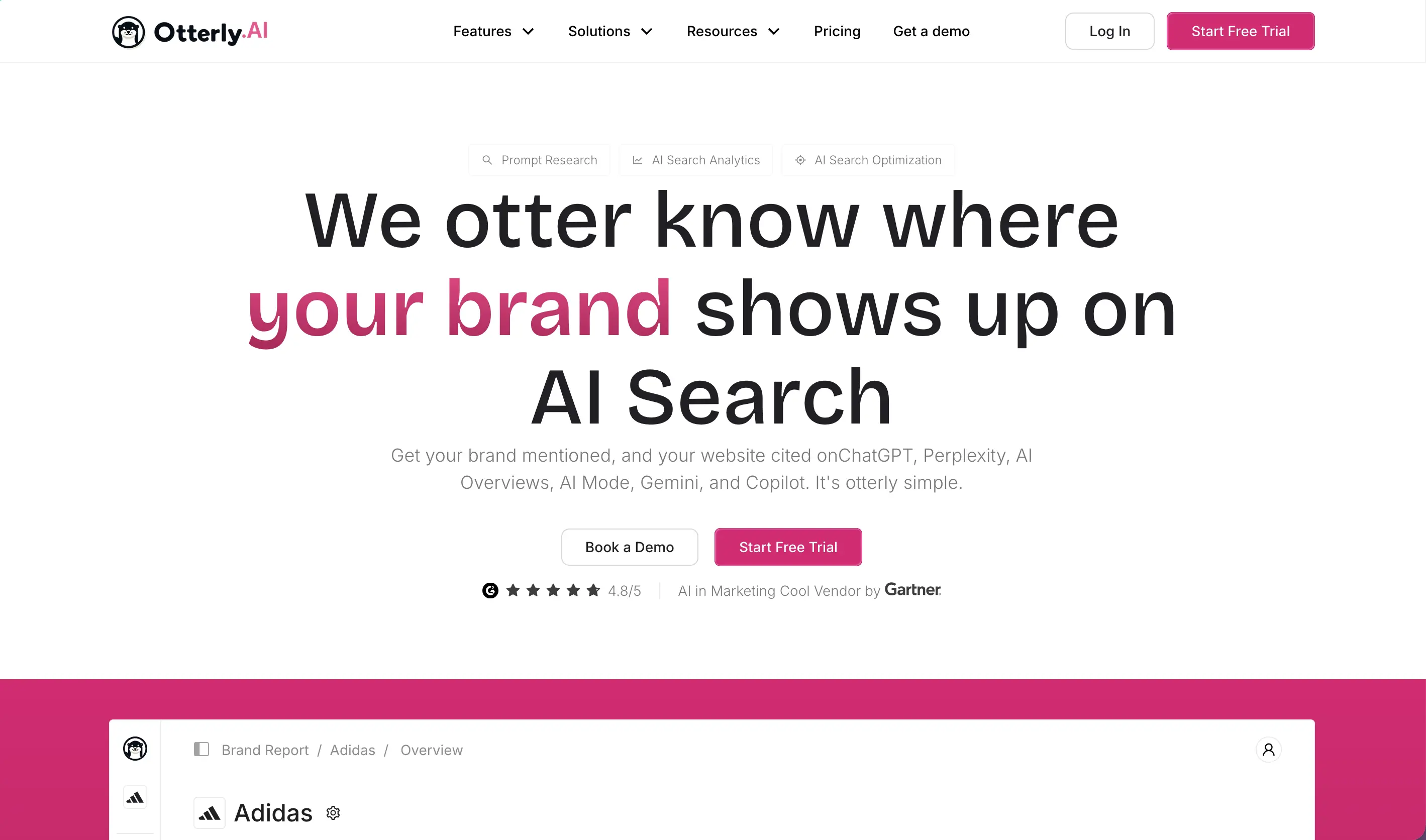
Otterly.AI is a practical entry point for businesses that want a small set of customer questions checked regularly. Its Lite plan includes daily monitoring across ChatGPT, Google AI Overviews, Perplexity, and Microsoft Copilot. Reporting covers brand visibility, sentiment, and the sources appearing in answers.
The product also includes prompt research, GEO audits, and optimization recommendations. These help a team move from “our brand is missing” to a list of issues to investigate. Its buying tradeoff is straightforward: the entry plan has a limited prompt allowance, and some engines cost extra. Calculate your required engine coverage before comparing its price with plans that bundle a different selection of platforms.
Key Features
- Daily prompt tracking: Automatically check your selected questions each day. This provides a regular record of brand appearances without repeating each test manually.
- Citation tracking: Inspect links and domains appearing in answers. Identify which of your pages receive citations and which external sources merit closer review.
- Competitor reporting: Compare mentions and brand positions across tracked prompts. Use the results to find questions where competing businesses receive more attention.
- Sentiment analysis: Monitor how AI answers describe your brand. Review changes in tone alongside the actual responses before deciding whether action is needed.
- Prompt research: Find questions related to your business and explore query fan-out. Use the suggestions to broaden coverage beyond obvious branded queries.
- GEO audits: Review website accessibility and content issues with optimization recommendations. These findings provide a starting point for improvements after a visibility gap appears.
- Team access and integrations: Share results with unlimited team members. Standard and Premium also include API, MCP, and Agent Analytics for connected reporting and investigation.
Pros
- Daily monitoring is included in the entry tier.
- Unlimited team members support shared review.
Cons
- Google Gemini, Google AI Mode, and Claude are paid add-ons.
- Lite includes only 15 prompts and one workspace.
Pricing
- Lite: $29/month. 15 prompts and four included engines.
- Standard: $189/month. 100 prompts, API/MCP, and Agent Analytics.
- Premium: $489/month. 400 prompts and higher audit and integration allowances.
5. Semrush
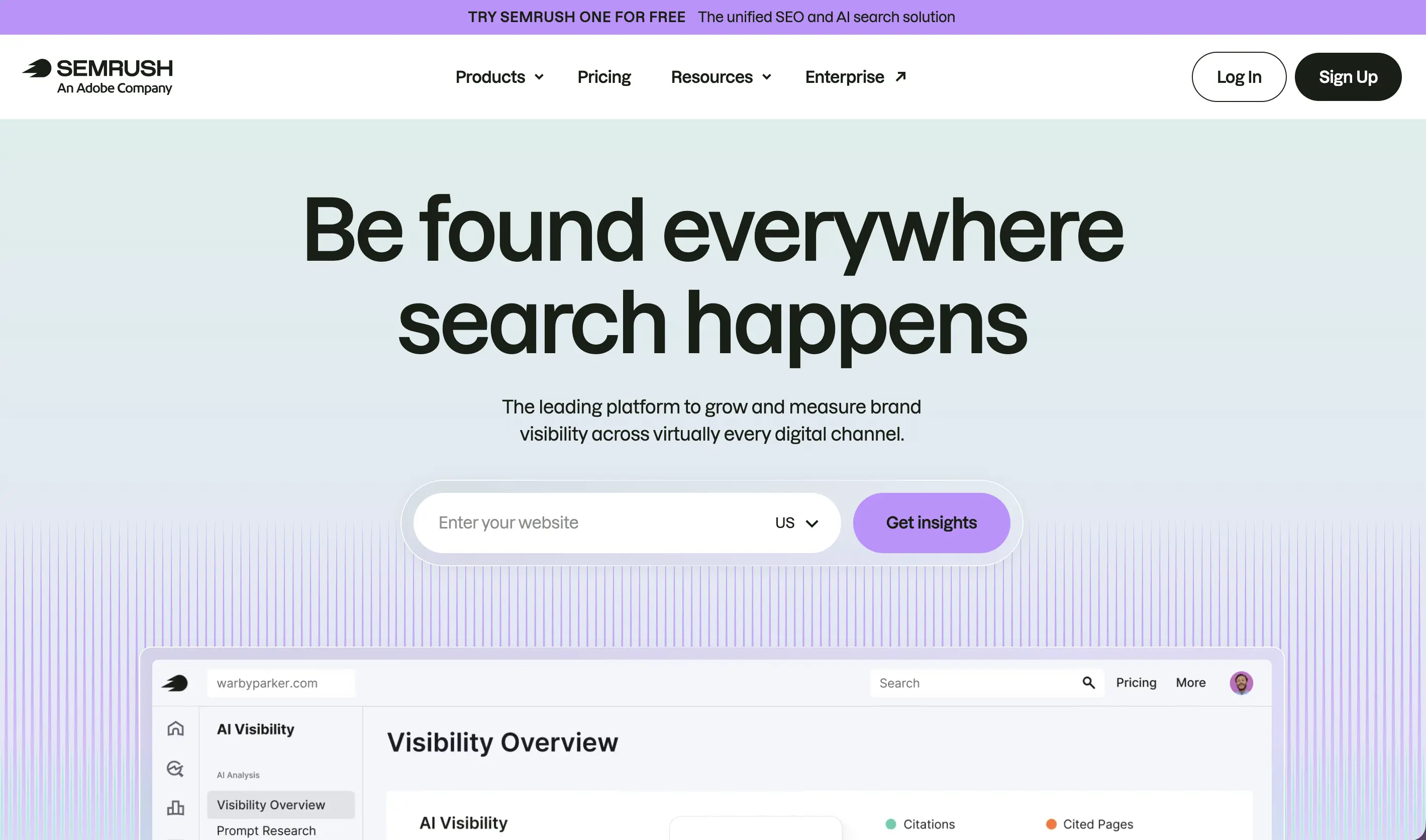
Semrush makes sense when AI search is becoming another part of an established SEO operation. Its AI offering includes prompt research, competitor analysis, brand reporting, and custom prompt monitoring. Combined packages add keyword research, position tracking, and site audits, giving teams one purchasing route for both types of work.
Choose the package carefully. A standalone AI Visibility subscription and an SEO + AI Search subscription have different allowances and purposes. Comparing only their entry prices hides that distinction. Semrush is useful for teams investigating search performance broadly, but a smaller business focused solely on a handful of AI questions may not need the combined suite.
Key Features
- Custom prompt tracking: Monitor chosen questions daily. Use a fixed set of commercially relevant prompts to follow changes in brand presence.
- Prompt research: Discover topics and questions to investigate in AI search. This helps extend research beyond the terms already in your SEO campaign.
- AI competitor research: Compare your brand with rivals across the platform’s AI data. Find subjects where competitors receive coverage that your business lacks.
- Brand performance analysis: Review visibility across supported AI platforms. Compare coverage by engine before relying on an overall score.
- Brand sentiment: Examine how AI systems describe your business. This helps identify themes that deserve a closer look in the underlying answers.
- AI readiness audits: Investigate website issues relevant to AI access and understanding. Use the findings to prioritize technical work alongside content changes.
- Combined SEO tools: Add keyword research, position tracking, and site auditing through SEO + AI Search plans. This supports a shared workflow for traditional rankings and AI visibility.
Pros
- Offers standalone AI analysis or combined SEO packages.
- Suits teams already managing traditional search in Semrush.
Cons
- AI domain and prompt allowances differ between packages.
- Extra users and reporting options can increase total cost.
Pricing
- AI Visibility Base: $99/month per domain, billed annually. 25 custom prompts and brand analysis for one domain.
- SEO + AI Search Starter: $199/month. 50 daily prompts, five monitored websites, and 500 SEO keywords.
- Pro+: $299/month. 100 daily prompts, 15 websites, and 1,500 SEO keywords.
6. SE Ranking
SE Ranking connects AI response analysis with the project management and reporting needs of an SEO agency. Its AI tools distinguish brand mentions from domain links, expose responses behind the metrics, and map cited sources. Traditional ranking, audit, and research capabilities remain part of the wider subscription.
This is useful when a client wants one account of their search performance rather than separate reports with conflicting definitions. However, SEO project capacity and AI project capacity should be checked independently. A plan with room for many SEO websites does not automatically give every client the same AI tracking allowance. Agencies should map their client requirements to both sets of limits before choosing a tier.
Key Features
- Mention and link tracking: Separate brand appearances from links to your domain. This clarifies whether a client is being recommended, cited, or both.
- Full AI responses: Inspect the answer behind a reported result. Use the wording and context to explain visibility changes to clients.
- Source mapping: Review cited domains, individual URLs, and source categories. Identify relevant blogs, media pages, or discussions for further investigation.
- Competitor analysis: Compare brands appearing for the same prompts. This helps find questions where a client loses attention to rivals.
- Location and language settings: Track supported markets and languages. Keep those settings consistent when comparing local or international performance.
- SEO project tools: Combine AI findings with keyword tracking, website audits, and backlink research. This supports clients whose search strategy includes both Google results and AI answers.
- Reporting and data connections: Bring findings into reports and supported analytics integrations. API and MCP options support additional data workflows, subject to access and usage terms.
Pros
- Combines AI reporting with established SEO delivery tools.
- Provides source and response detail for client explanations.
Cons
- Core and Growth both start with 25 daily AI prompts.
- More SEO projects do not imply equivalent AI project allowances.
Pricing
- Core: $129/month. 10 SEO projects, one manager seat, 2,000 SEO keywords, and 25 daily AI prompts across five engines.
- Growth: $279/month. 30 SEO projects, three seats, 5,000 SEO keywords, and the same starting AI prompt allowance.
7. AIclicks
AIclicks combines prompt monitoring with investigation of the sources appearing in AI answers. Teams can review visibility, compare competing brands, and use the findings to plan content. It also includes article generation and the Clicky AI Agent, making it relevant when analysis needs to lead directly to production work.
The plan structure links price to prompts, selected models, websites, and articles. That makes the right tier depend on both research volume and publishing needs. Its coverage also mixes consumer platforms with explicitly labeled API models. Check that the environment being tested matches your reporting objective before describing every result as the answer a customer would see in the corresponding app.
Key Features
- Prompt monitoring: Track selected questions across included models. Follow changes in brand visibility by topic rather than relying on a single test.
- Prompt discovery: Explore related questions and estimated demand. Use these estimates as research signals when deciding what content to prioritize.
- Citation research: Inspect the sources appearing in answers. Find specific pages and domains to investigate when competitors receive citations.
- Competitor analysis: Compare brands mentioned for target questions. Use the results to identify topics where your own coverage may be weak.
- Clicky AI Agent: Use the built-in agent for supported analysis and action tasks. It helps connect findings with follow-up work in the same workspace.
- Article generation: Create drafts around relevant topics and content gaps. Review the claims and usefulness of each article before publishing through supported CMS connections.
- AI traffic reporting: Use GA4 integration on eligible plans to examine AI referral visits. Compare traffic with visibility changes without treating every mention as a visit or conversion.
Pros
- Includes article generation alongside monitoring.
- Higher tiers support multiple websites and countries.
Cons
- Starter covers one website and one country.
- Included model slots and article allowances limit each tier.
Pricing
- Starter: $59/month. 30 prompts, three models, one website, five articles.
- Pro: $189/month. 150 prompts, four models, unlimited websites, 15 articles.
- Business: $499/month. 300 prompts, six models, 30 articles.
8. LLMrefs
LLMrefs begins with keywords rather than requiring you to build every prompt yourself. It generates related questions and aggregates brand performance across the results. For an SEO team with an existing keyword list, that provides a familiar starting point for investigating AI search without treating a keyword and a conversational prompt as identical.
Its reports include brand comparisons, share of voice, positions, and cited source URLs. Multiple projects and CSV/API access support agency workflows. The main consideration is control: generated prompts make coverage easier, but you should inspect the questions behind each keyword before treating the resulting score as a measure of your buyers’ needs. The publicly advertised pricing offer should also be reconfirmed at checkout.
Key Features
- Keyword-based setup: Start with terms from your existing SEO research. This gives you a familiar way to organize AI visibility around products and categories.
- Generated prompts: Expand keywords into related questions automatically. Review those questions to make sure they reflect the customers you want to reach.
- Multi-engine analysis: Compare results across supported AI platforms. Identify where brand presence differs instead of assuming one engine represents them all.
- Brand rankings and share of voice: Compare brands within the collected answers. Use the metrics to investigate competitors appearing for the same keyword topics.
- Cited URLs: Review the specific pages referenced across results. These can reveal content formats or information gaps worth investigating.
- Country and language coverage: Research supported markets and languages. This helps assess regional differences while keeping the chosen settings clear in reports.
- Projects and exports: Organize multiple brands or clients and access results through CSV or API. Shared access makes the data easier to use in agency reporting.
Pros
- Reduces the work of building an initial prompt set.
- Supports multiple projects and team members under one subscription.
Cons
- Generated questions still need relevance checks.
- Weekly refreshes may not fit daily campaign monitoring.
Pricing
- All in One: Advertised at $79/month. Includes 500 prompts, weekly refreshes, all supported engines, unlimited projects/users, and CSV/API. The offer is labeled limited-time; confirm current terms before subscribing.
9. AirOps
AirOps focuses on helping marketing teams research, create, update, and manage content at scale. Its platform brings together AI search insights, content production tasks, brand knowledge, and integrations with publishing and marketing systems.
Its value becomes clearer when a company has a large content library. For example, an ecommerce brand might need to update hundreds of product category pages, improve missing information, and keep content consistent across different markets. AirOps supports repeatable workflows for this kind of work rather than leaving marketers to coordinate every update manually.
Key Features
- AI search insights: Use visibility findings to identify content opportunities. Confirm your plan’s answer-engine coverage before setting reporting expectations.
- Quill: Bring research, drafting, and editing into an assisted content workflow. This helps move a topic from an idea toward a reviewable article.
- Playbooks: Reuse defined workflows for recurring content tasks. A shared process reduces the need to rebuild instructions for every article or update.
- Brand Kits: Apply brand context and writing guidance to generated work. This helps keep output aligned with the business and its preferred voice.
- Knowledge bases: Supply relevant source material for research and writing. Grounding drafts in approved information makes factual review more manageable.
- Content refresh workflows: Update existing pages as well as create new ones. This is useful for maintaining a large library with changing product information.
- CMS connections and human review: Connect production with publishing while keeping editorial checkpoints. Reviewers can assess accuracy and quality before content goes live.
Pros
- Supports content operations beyond a tracking dashboard.
- Connects brand context, production, and publishing.
Cons
- Task usage requires a different cost estimate from prompt-based pricing.
- Solo insights cover ChatGPT only; broader insights require Pro.
Pricing
- Solo: A free tier with 35,000 tasks, one Brand Kit, three knowledge bases, and one user.
- Pro: Contact AirOps for pricing. 100,000 tasks, broader engine insights, and unlimited team seats.
- Enterprise: Custom pricing. Tailored limits, brand resources, agent builds, and onboarding.
10. Scrunch AI
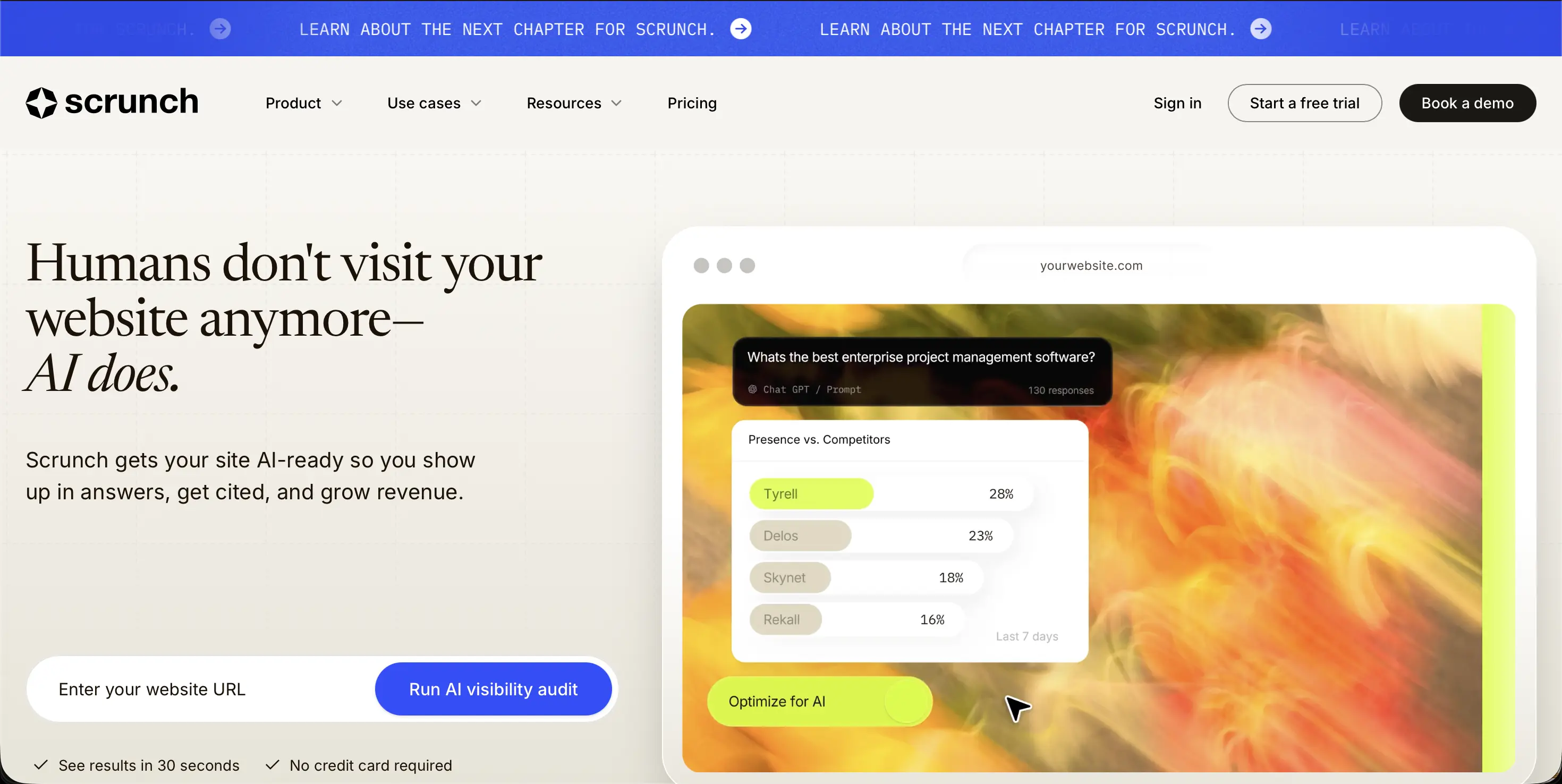
Scrunch AI connects AI visibility monitoring with website-level analysis. It tracks prompts, brand presence, citations, source URLs, competitors, and visibility trends. Site Optimization and Agent Traffic then help teams investigate whether content gaps, page issues, or AI crawler activity may be contributing to weak visibility.
Its Enterprise offering also includes Agent Pages through the Agent Experience Platform. Agent Pages delivers a cleaner, server-rendered version of selected website content to AI retrieval agents while leaving the human-facing website unchanged. This is a separate Enterprise deployment feature rather than part of the Core monitoring plan.
Key Features
- AI visibility monitoring: Track selected prompts across supported AI platforms and follow changes in brand presence over time.
- Citation and source analysis: Identify the domains and exact URLs referenced in AI answers to understand which pages are influencing the responses.
- Competitor benchmarking: Compare your answer share with competing brands and find prompts where competitors appear but your brand is missing.
- Explorer and segmentation: Analyze results by AI platform, topic, page URL, competitor, date range, persona, or market, depending on your plan.
- Insights and recommendations: Surface meaningful visibility changes, content gaps, and suggested actions instead of relying only on overall scores.
- Site Optimization: Audit important pages for content, accessibility, and technical issues that may make them harder for AI agents to understand or retrieve.
- Agent Traffic: Monitor visits from AI bots and separate retrieval, indexing, and training activity. You can also see which pages AI agents access most often.
- Agent Pages and AXP: Enterprise customers can deliver cleaner, server-rendered pages to AI retrieval agents through CDN-level integrations without changing the human-facing website.
Pros
- Connects AI visibility monitoring with website and citation analysis.
- Core includes five monthly site audits, AI agent traffic monitoring, and five users.
Cons
- Core is limited to four AI platforms, one country, one language, and one persona.
- Expanded platform coverage, API access, AXP, and advanced SSO require Enterprise.
Pricing
- Core: $250/month. Includes 125 prompts, 5,000 monthly responses, five site audits, one workspace, five users, and four AI platforms.
- Enterprise: Custom pricing. Adds nine-platform coverage, custom limits, complete site audits, AXP, APIs, integrations, SSO, and dedicated support.
10 Best LLM SEO Tools Compared
Use this table to compare the best LLM SEO tools by their main job. Prices are in USD and reflect monthly billing unless stated otherwise. Platform coverage and usage limits vary by plan.
| Tool | Best For | Standout Features | Starting Price |
|---|---|---|---|
| Botric | AI visibility tracking, content optimization, and blog generation | Prompt tracking, Prompt Research, citation analysis, Brand Profile checks, GEO audits, Blog Agent, Page Agent | $15/month |
| Profound | Enterprise AI intelligence and marketing workflows | Answer Engine Insights, Prompt Volumes, Agent Analytics, AI Marketer | Custom |
| Peec AI | Cited-source and competitor research | Daily prompts, source URLs, topic analysis, competitor metrics, Actions, Impact | $95/month |
| Otterly.AI | Daily checks of customer questions | Citation tracking, sentiment, competitor reports, prompt research, GEO audits | $29/month |
| Semrush | Adding AI research to an SEO workflow | Custom prompt tracking, prompt research, competitor analysis, AI readiness audits, SEO tools | AI Visibility: $99/month per domain, billed annually; combined package: $199/month |
| SE Ranking | Client reporting across SEO and AI search | Full AI responses, source mapping, location settings, SEO audits, reports, API/MCP | $129/month |
| AIclicks | Citation research and content production | Source tracking, prompt discovery, competitor analysis, Clicky agent, article generation | $59/month |
| LLMrefs | Expanding SEO keywords into AI research | Generated prompts, share of voice, cited URLs, country settings, CSV/API, multiple projects | $79/month |
| AirOps | Repeatable content production and updates | Quill, Playbooks, Brand Kits, knowledge bases, CMS connections, review controls | Paid pricing on request |
| Scrunch AI | Site access and AI visibility diagnostics | Prompt Manager, citations, page audits, persona comparisons, agent traffic | $250/month |
How We Evaluated These LLM SEO Tools
We reviewed official product pages, pricing pages, and documentation against seven criteria:
- AI platform coverage: Engines supported, plan restrictions, and clarity about the response environment being tested.
- Prompt tracking: Custom questions, topic organization, location settings, and scheduled tests.
- Brand mentions and citations: Separate reporting for brand appearances, linked websites, and cited URLs.
- Competitor benchmarking: Comparisons using the same questions, engines, and reporting periods.
- Content generation and optimization: Audits, recommendations, content briefs, drafting, and page improvements.
- Reporting and integrations: Export options, analytics connections, team access, APIs, and client workflows.
- Pricing and overall value: Included prompts, engines, projects, content allowances, and additional charges.
Botric is our product. We evaluated it using the same criteria as the other tools. This comparison is based on information from official product and pricing pages reviewed in November 2026. Features and prices may change.
What Do LLM SEO Analysis Tools Actually Measure?
LLM SEO analysis tools turn a sample of AI answers into metrics. The useful question is what each metric counts and which responses form its denominator.
| Metric | What It Tells You | What to Check |
|---|---|---|
| Brand mention rate | Share of tested answers naming your brand | Are aliases recognized and repeated mentions deduplicated? |
| Citation rate | Share of answers citing the chosen domain or pages | Does the vendor count citations to your site separately? |
| Prompt visibility | Questions for which your brand appears | Does one successful run count, or is repeated presence required? |
| Share of voice | Your portion of the measured brand mentions | Which brands, prompts, and weights are included? |
| Answer position | Where the brand appears within responses | Are absent brands excluded from the average? |
| Sentiment | How the answer describes the brand | Can you read the text behind the automated label? |
| Cited sources | Domains and pages referenced in answers | Are explicit citations separated from retrieved sources? |
| Visibility trends | Movement across repeated measurements | Did the prompt set, model, or location change? |
The best LLM SEO analysis software should make these definitions inspectable. A score of 70 in one product is not necessarily better than 60 in another.
LLM SEO Checking vs. Monitoring vs. Optimization
LLM SEO checking tools answer a narrow question about the current result. Monitoring repeats the check. Analysis investigates the pattern, and optimization changes the material that could improve future answers.
| Job | CRM Example | Useful Output |
|---|---|---|
| Checking | Test “best CRM for a five-person sales team” | A saved answer with mentions and citations |
| Monitoring | Repeat the question under consistent conditions | A history of appearances and absences |
| Analysis | Compare the cited pages when rivals appear | A specific content or source gap |
| Optimization | Improve the small-team product guide | A reviewed update to publish and retest |
An LLM SEO checker is useful for an initial diagnosis. LLM SEO monitoring tools are more useful for determining whether that result repeats. LLM SEO optimization software should help you act on the finding through audits, editing, drafting, or an organized task list.
When comparing LLM SEO checking software, ask how results are collected. An API response and a consumer app response can differ because of models, retrieval settings, location, or session context. Neither method samples every user’s experience. Keep the testing environment consistent and label it clearly.
How to Choose the Right LLM SEO Tool
The best LLM SEO software depends on the work you need to do after finding a visibility gap. Start with your main use case, then compare the included engines, prompt limits, and integrations before choosing a plan.
For Tracking and Content Improvements
- For tracking, content optimization, and blog generation: Botric. Connect prompt testing and citation analysis with GEO audits and content recommendations. Use Blog Agent for new articles and Page Agent to improve existing pages.
- For citation research and content actions: AIclicks. Investigate cited sources and competitor appearances, then use article generation and Clicky to help with follow-up work. Higher plans add GA4 and broader integration access.
- For repeatable content production: AirOps. Use Quill, Playbooks, Brand Kits, and knowledge bases to support research, writing, and updates. CMS connections and human review suit businesses managing a substantial content library.
For Monitoring and Source Research
- For investigating cited pages and competitors: Peec AI. Review source URLs, share of voice, sentiment, and topic-level performance. Actions provides recommendations for content, technical work, and outreach based on those findings.
- For daily mention and citation checks: Otterly.AI. Monitor a focused set of prompts each day and compare brand presence over time. Prompt research and GEO audits help you decide what to investigate next.
- For starting with an SEO keyword list: LLMrefs. Generate related prompts from your keywords and compare brand performance across engines. Cited URLs, multiple projects, and exports support research across brands or clients.
For SEO Operations and Enterprise Requirements
- For SEO research alongside AI visibility: Semrush. Combine prompt and competitor research with traditional keyword tracking and site audits through a combined plan. This is useful when both types of search are part of your existing workflow.
- For agency reporting across SEO and AI search: SE Ranking. Bring AI response analysis, source mapping, and traditional SEO tools into client delivery. Check AI allowances separately from the number of SEO projects included.
- For enterprise AI intelligence and marketing workflows: Profound. Combine answer-engine research, prompt demand, and Agent Analytics with AI Marketer and reusable agents. Scope integrations and usage before comparing enterprise LLM SEO optimization platforms.
- For technical investigation of AI visibility: Scrunch AI. Pair prompt and citation monitoring with page audits, persona comparisons, and agent traffic. Evaluate its separate AXP offering if you also need to change how content is delivered to AI agents.
Test your shortlisted LLM search optimization platform with real customer questions. A useful trial should leave you with specific pages to improve, sources to investigate, and results you can measure again.
How to Measure Whether LLM SEO Optimization Is Working
Set a baseline before changing content. Save the prompt list, selected engines, location, language, date range, and the pages you plan to update. Keep a fixed reporting set while testing new prompts separately.
Follow brand mention rate, citation rate, prompt coverage, share of voice, and the URLs being cited. Segment by topic and engine so improvement on easy branded questions does not hide weak commercial visibility.
Then compare those results with AI referral sessions and relevant conversions in your analytics. LLM SEO tracking software measures sampled answer visibility; web analytics measures identifiable visits. Neither captures every influence on a purchase. Someone may read an AI recommendation and later search your brand directly.
Record publication dates and compare multiple runs. A before-and-after improvement is evidence worth investigating, but model changes, new sources, competitors, and ordinary response variation may contribute.
Conclusion: Which LLM SEO Tool Is Worth Trying Out?
The best tool for LLM SEO depends on what you need to improve. Try Peec AI for source research, Otterly.AI for daily monitoring, or Profound for enterprise intelligence. AirOps suits content production, while Semrush and SE Ranking connect AI visibility with existing SEO work.
Botric is the overall best option if you want to track AI visibility, investigate gaps, and create or improve content in one platform. Prompt Research, citation analysis, GEO audits, and its content agents connect the findings with practical next steps.
Find the questions where your brand is missing, then create content to address them. Start your seven-day Botric trial to test relevant prompts and identify your next content opportunity.
Frequently Asked Questions
What Is the Best LLM SEO Tool?
Choose Botric for tracking connected to audits and content improvements, Profound for enterprise intelligence, or Peec AI for source-focused analysis. The best tools for LLM SEO solve different problems. Compare a sample of your own questions before choosing, especially if you need particular engines, markets, or integrations.
What Is the Best LLM SEO Analysis Tool?
Botric is a strong LLM SEO analysis tool for tracking prompt performance, brand mentions, citations, competitors, and content gaps across multiple AI platforms. It also connects the findings with GEO audits and prioritized recommendations. Peec AI is useful for deeper source investigation, Profound suits enterprise analytics, and LLMrefs works well when research begins with SEO keywords.
What Is the Best LLM SEO Optimization Tool?
Botric connects tracking with audits, Blog Agent, and Page Agent. AirOps is another option when you need repeatable content production and publishing workflows. Choose LLM SEO optimization tools based on the work they help complete, such as updating a product page or producing a reviewed article, rather than the number of recommendations displayed.
What Are the Best LLM SEO Checking Tools?
Botric is a strong LLM SEO checking tool because it combines weekly automated tracking with manual tests through Prompt Research. It shows brand mentions, citations, answer position, sentiment, and competitor visibility across supported AI platforms. Otterly.AI is better suited to daily monitoring, while LLMrefs turns SEO keywords into related AI prompts for weekly analysis.
Which LLM SEO Tools Track Website Citations Across Multiple AI Platforms?
Botric, Peec AI, Otterly.AI, AIclicks, LLMrefs, and Scrunch AI track citations or source URLs across multiple AI platforms. Botric separates brand mentions, website citations, and third-party sources, while Peec AI and Scrunch AI provide deeper source-level analysis. Check which engines each plan covers and whether the tool shows individual cited URLs rather than domain-level totals.
Which LLM SEO Tools Are Best for Agencies?
SE Ranking suits agencies delivering traditional SEO alongside AI visibility reporting. LLMrefs supports keyword-based research across multiple client projects. Botric is a strong option for agencies that want separate workspaces alongside prompt tracking, competitor analysis, GEO audits, and content generation. Its Infinity plan supports five workspaces and five websites. Compare workspace limits, seats, reporting options, and prompt allowances before choosing.
What Is the Difference Between LLM SEO and Traditional SEO?
Traditional SEO focuses on visibility in search results. LLM SEO focuses on how AI answers mention, describe, recommend, and cite a business. The work overlaps: useful content and accessible pages matter to both. Google says its AI search features have no additional technical eligibility requirements beyond the relevant Search requirements (Google Search Central).
Can LLM SEO Tools Help Improve Website Citations?
They can identify useful work, including missing information, inaccessible pages, outdated claims, or sources where competitors appear. Some tools also help draft or edit content. No tool can guarantee a citation. An improvement should be assessed through repeated tests and relevant traffic data, rather than one successful answer after publication.
How Much Does LLM SEO Software Cost?
In this comparison, paid entry plans include Botric at $15/month, Otterly.AI at $29/month, and AIclicks at $59/month. Enterprise products may require a quote. Pricing for LLM SEO analysis and AI visibility tracking depends on prompts, models, frequency, projects, and integrations. Check annual billing commitments and engine add-ons before comparing headline prices.
How Often Should Businesses Monitor LLM SEO Performance?
Weekly checks can suit a steady content program; daily checks provide more observations for active campaigns or competitive categories. Consistency matters more than reacting to every fluctuation. The best SEO tools for LLM performance tracking should retain comparable answers over time. Test the same questions under similar conditions and review patterns across several runs.