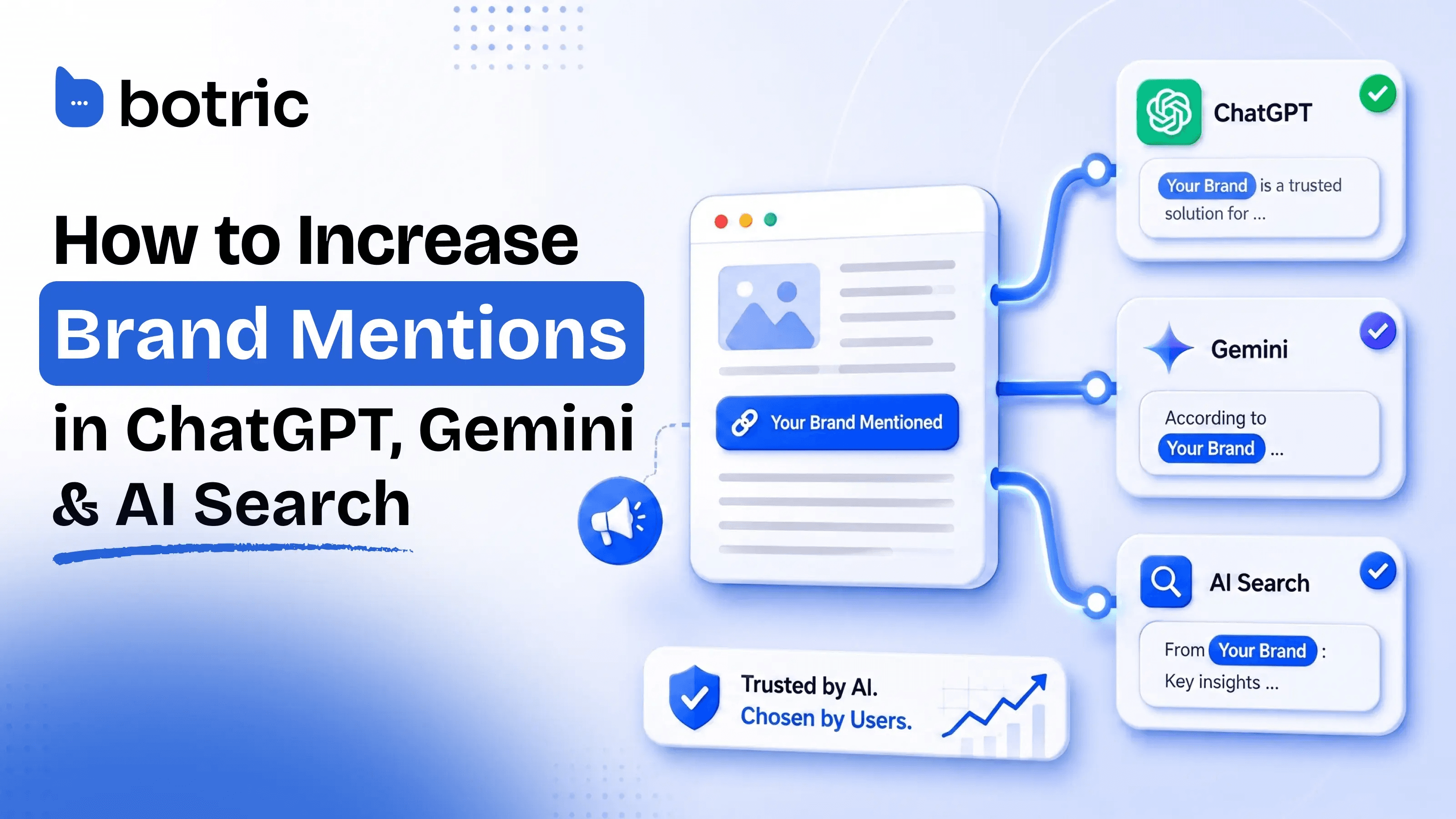
To increase brand mentions in AI search, you need to build authority across multiple platforms, structure content for machine extraction, and earn third-party citations, not just rank on Google. Your brand can rank on page one of Google and still disappear from the answers buyers get from ChatGPT, Perplexity, and Gemini. This guide shows you exactly how to fix that.
To increase brand mentions in AI search:
- Audit your visibility across ChatGPT, Gemini, Claude and Perplexity
- Publish answer-first, fact-dense content
- Build topical authority with interconnected content clusters
- Earn citations on trusted third-party platforms
- Keep brand information consistent across the web
- Monitor citation share and competitor visibility weekly
What Is a Brand Mention in AI Search?
A brand mention in AI search is any instance where an LLM names, recommends, or cites your brand inside a generated answer and it operates on entirely different logic than a backlink. In traditional SEO, a link passes authority through the link graph.
In AI search, a mention shapes buyer perception at the moment a shortlist forms, often before your sales team knows a prospect exists.
What is Generative Engine Optimization?
Generative Engine Optimization (GEO) is the practice of optimizing content so that AI answer engines such as ChatGPT, Claude, Perplexity, Google AI Overviews surface and cite your brand in their responses.
51% of B2B software buyers now start research in an AI chatbot more often than Google, and 71% use one somewhere in the process, per the G2 Answer Economy report (April 2026).
What Happens When Your Brand Gets Cited in AI Answers
According to Seer Interactive, ChatGPT referral traffic converts at 15.9% compared to 1.76% for Google organic search, approximately 9x higher. A mention in an AI answer is not a vanity metric; it is a high-intent referral.
Botric's AI-visibility tracking shows that most brands have little to no AI-engine visibility for topics like this one, measured by tracking how often AI answer engines cite a brand across monitored query runs, illustrating precisely the gap most brands are sitting in right now.
Note: Botric is an AI search visibility and monitoring platform not a content optimization or RAG visibility tool. Its purpose is to track and improve how often AI engines cite your brand.
How to track your current brand mentions in AI search
Start your audit before you create a single piece of new content otherwise you're optimizing blind.
Step 1: Run Manual AI Search Queries
Open ChatGPT, Perplexity, Claude, Gemini, and Google's AI Overviews, and start asking questions your customers actually ask. Pay attention to what comes back. Which sources are getting cited?
Test at least 10–15 queries that should surface your brand: category questions ("best your category tools"), comparison queries ("X vs Y"), and problem-based questions your buyers type into AI tools.
Step 2: Document the Visibility gap
For each query, record: whether your brand appears, whether a competitor appears instead, the context of the mention (recommended, compared, dismissed), and which platform cited it. One of the most actionable signals in tracking is the gap between mentions and citations.
An AI answer might name your brand as a recommended solution but link to a competitor's page, a review site, or no source at all. That pattern reveals a content trust gap: the model recognizes your brand but doesn't trust your content enough to use as a source.
Step 3: Establish a Weekly baseline.
Repeat the same query set weekly. AI recommendations shift as models update, sources change, and competitor signals improve. Brands can gain or lose visibility depending on how well their information stays consistent, current, and verifiable. Tools such as Botric, and others in the AI search visibility monitoring space automate this tracking across LLM versions.
How to Automate Tracking Your Brand Mentions With Botric
Everything above can be done manually: running the same prompts across ChatGPT, Gemini, Claude, and Perplexity, recording which brands appear, comparing competitors, and repeating the process every week.
Botric automates that workflow so you can spend less time collecting data and more time improving your visibility.
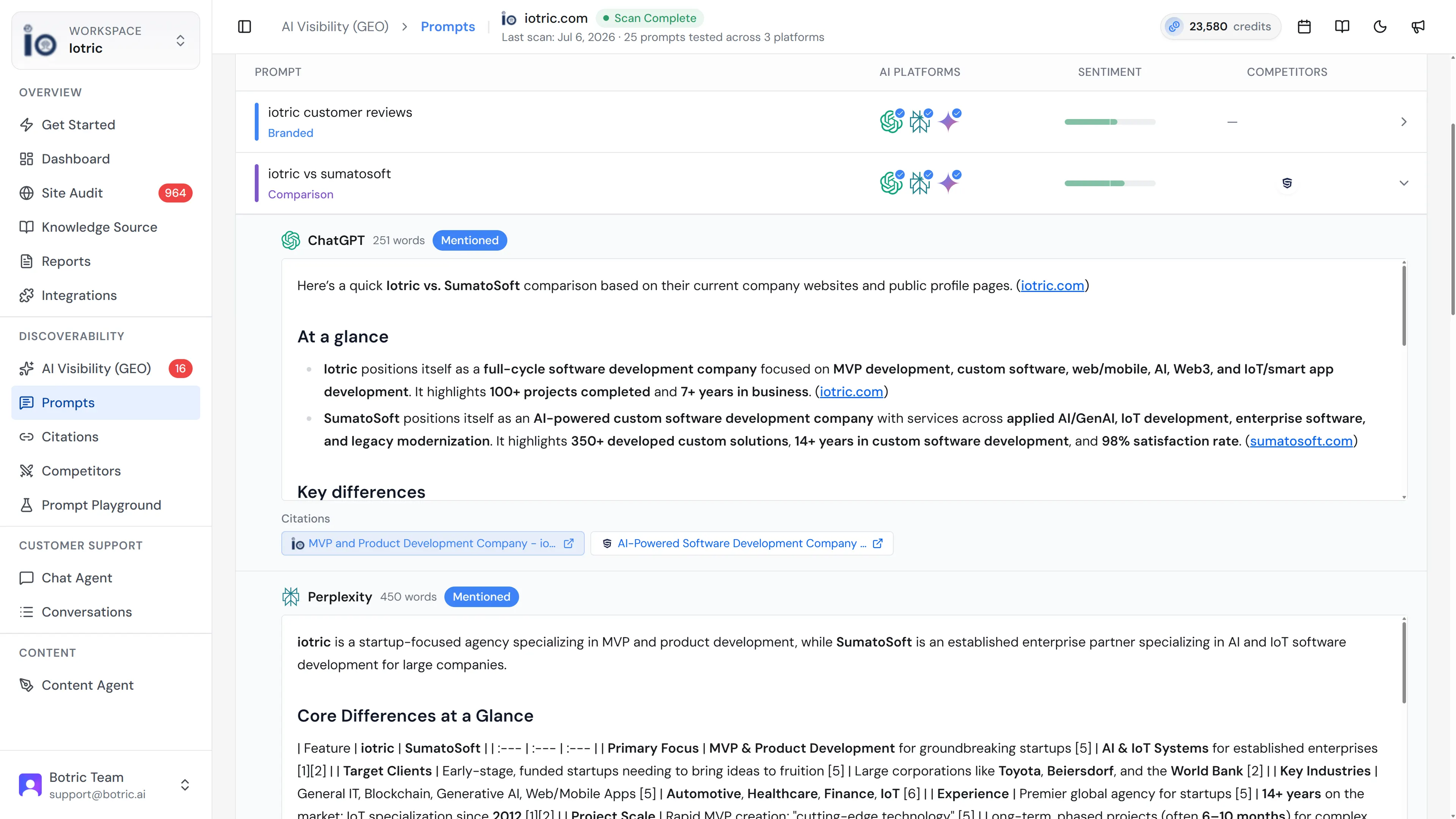
1. Monitor Your AI Visibility Across Every Major LLM
Start with an AI Visibility Audit to measure how often your brand appears across ChatGPT, Gemini, Claude, and Perplexity for the prompts that matter to your business.
Instead of manually testing dozens of searches each week, Botric continuously tracks your brand mentions, citation share, competitor visibility, and overall AI Visibility Score from a single dashboard. The score combines your mention rate, citation rate, position, and sentiment across supported AI platforms, giving you a clear baseline and making it easy to measure progress over time.
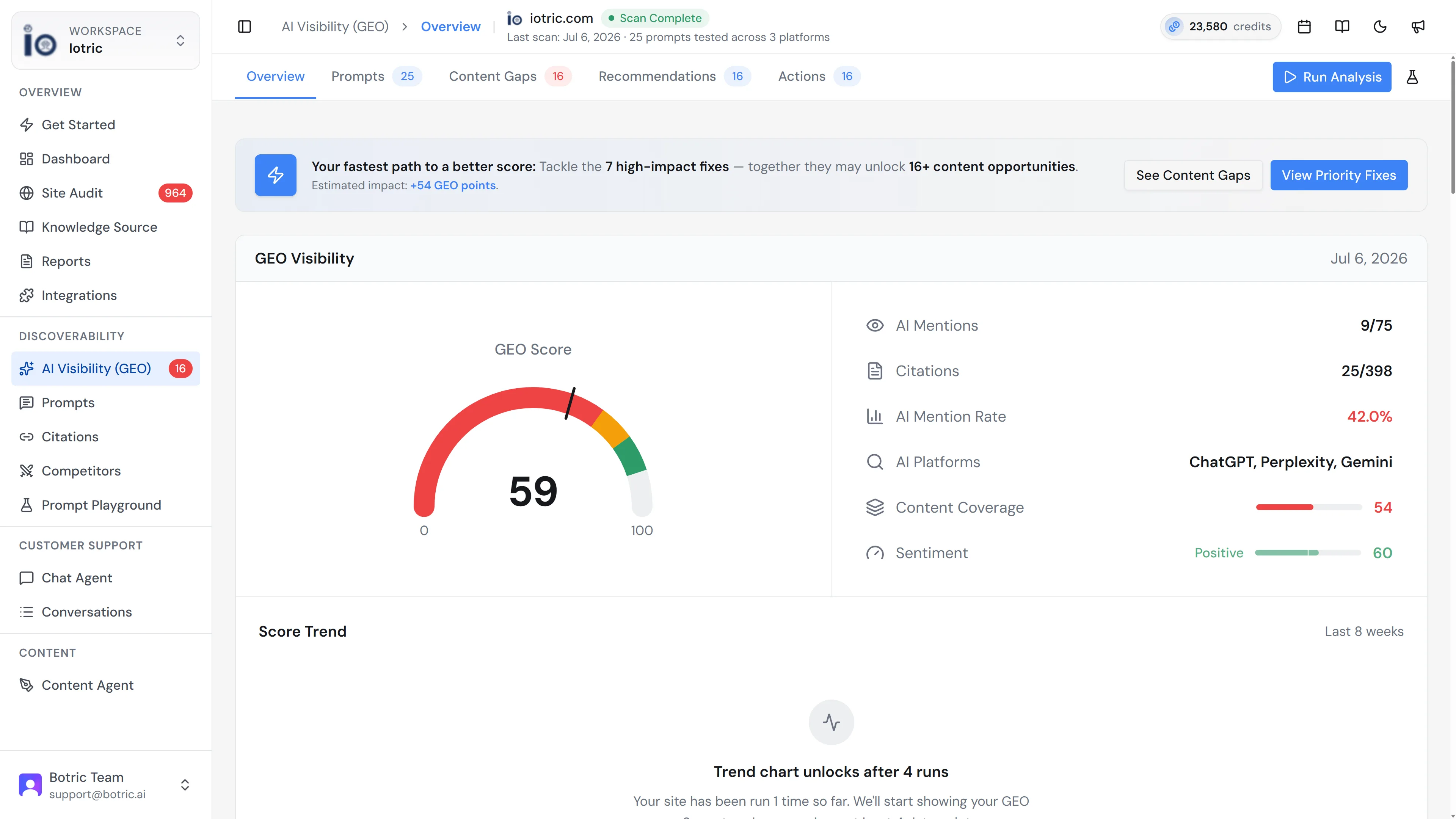
2. Find the Gaps Keeping Competitors Ahead
Visibility data only tells you where you stand. To improve it, you need to understand why competitors are being cited instead.
Botric benchmarks your brand against competitors using the same prompts, showing exactly where you're missing from AI answers and which competitors are being recommended instead. It also identifies content gaps, entity signals, and citation opportunities that may be limiting your visibility, then prioritizes recommendations so you know what to fix first instead of guessing.
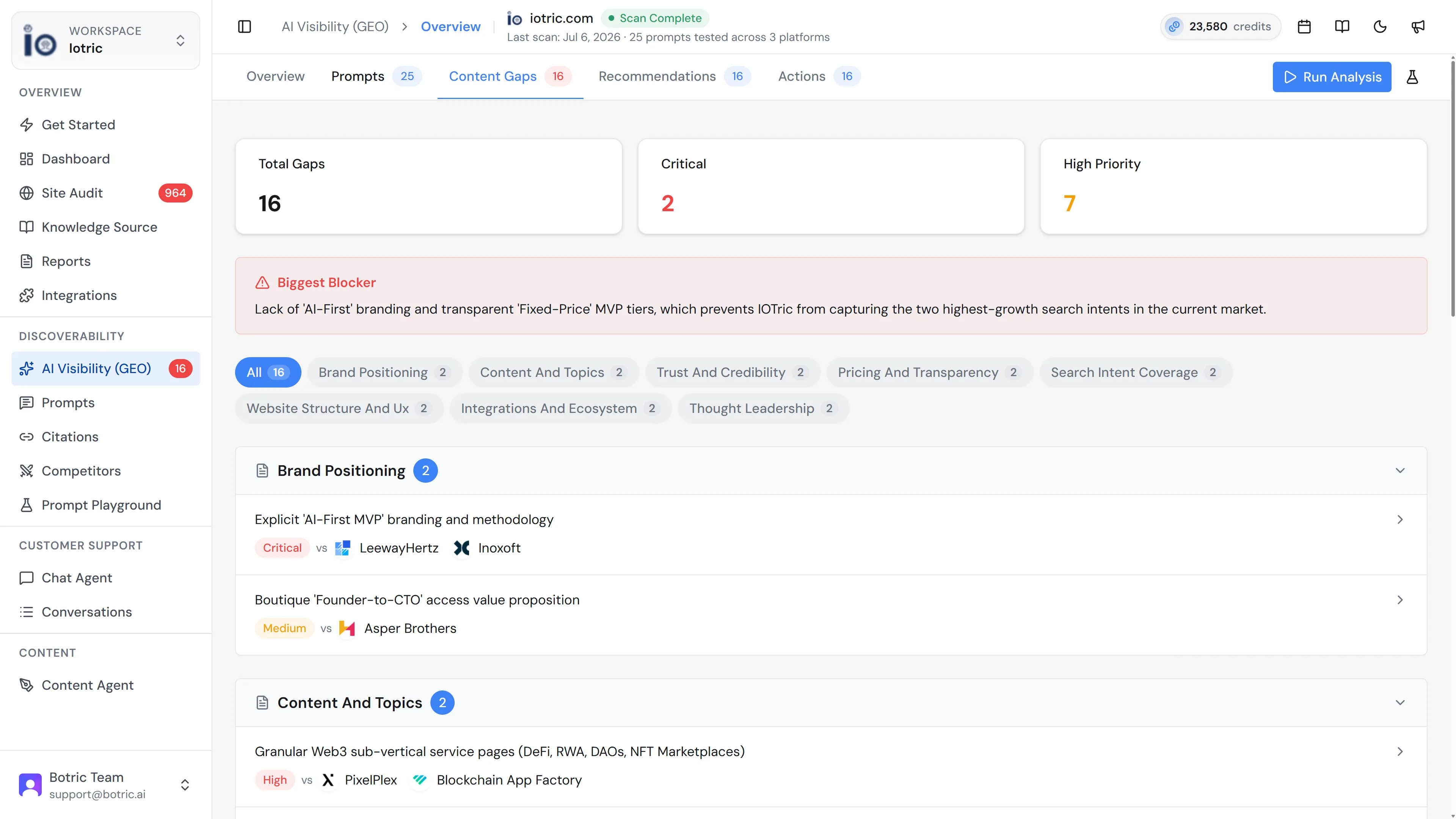
3. Fix Technical and Content Issues That Block AI Visibility
Strong content won't help if AI crawlers can't access your site or your pages aren't structured for extraction.
Botric checks technical factors that influence AI discoverability, including schema markup, llms.txt, robots.txt directives, and whether crawlers such as GPTBot, ClaudeBot, Google-Extended, and PerplexityBot can access your content. It also helps identify pages that need stronger answer-first formatting or additional topical coverage.
These technical issues are often the reason a brand shows 0% AI visibility despite having quality content.
4. Set it up once, then just act on the reports
Once your project is configured, Botric continuously monitors your AI visibility and reports how your citation share changes over time. Instead of manually re-running prompts every week, you receive ongoing insights into what's improving, what competitors are doing differently, and which content should be updated or created next.
You can run a free AI visibility audit on your own site to see exactly where you stand across ChatGPT, Perplexity, Gemini, and Claude before deciding where to focus first.
What Metrics Should You Track : Key Checklist
| Audit dimension | What to document |
|---|---|
| Mention frequency | How often your brand appears per 10 queries |
| Competitor gap | Which rivals appear where you don't |
| Citation vs. mention | Named but not linked = trust gap |
| Platform variance | Perplexity vs. ChatGPT vs. Claude results |
| Context/sentiment | Recommended, neutral, or negative framing |
Most brands checking their GEO score land in the Critical range on Botric's 0–100 rubric, meaning minimal to no GEO presence. This score is derived from a sample of monitored queries run across four AI engines (ChatGPT, Perplexity, Claude, and Gemini); citation share is calculated as the percentage of query runs in which the brand is named or sourced in the generated answer, then normalized to a 0–100 scale where scores below 20 indicate critical absence. That baseline is what you're trying to move.
3 Content Moves that actually get you cited by LLMs
Most brands chase volume. LLMs reward depth. Here are the three moves that actually shift your citation rate.
Move #1: Publish fact-dense, answer-first content
A Search Engine Land study found 52.2% of cited passages contained original or owned data, and the "Generative Engines and User Trust" study by researchers at Princeton and Georgia Tech found that adding statistics, expert quotations, and structured data increased AI visibility by up to 40%.
Front-load every page: 44.2% of all LLM citations are drawn from the first 30% of content , making opening paragraphs the highest-leverage GEO investment on any page, per Growth Memo (February 2026).
An agile content strategy matters here. Cosmetically refreshing a date without updating the underlying facts doesn't register as fresh to modern LLMs; substantive changes to data, structure, and claims are what signal recency.
Before / After: restructuring for LLM citation
Before thin page excerpt (~80 words, answer buried):
"AI search is becoming more popular. Many brands are trying to figure out how to show up in tools like ChatGPT and Perplexity. There are a few things you can do to improve your chances. One approach is to make sure your content is well-written and covers the topic thoroughly. You should also think about your off-site presence. Getting mentioned on other websites can help. Overall, a consistent strategy is important for long-term results."
No data. No definition. Answer implied but never stated. An LLM scanning this passage finds nothing extractable, no quotable claim, no named statistic, no clear entity.
After restructured, answer-first version (~90 words):
"To increase brand mentions in AI search, publish answer-first content that leads with a direct response, one named statistic, and a clear entity definition. The Princeton/Georgia Tech GEO study found that adding statistics and structured data increases AI visibility by up to 40%. Generative Engine Optimization (GEO) is the practice of structuring content so AI answer engines ChatGPT, Perplexity, Gemini surface and cite your brand. For a deeper breakdown of why pages go uncited, see why your website isn't showing in AI search."
Answer in sentence 1. Named stat with source in sentence 2. Definition in sentence 3. Internal link in sentence 4. In Botric's monitored query runs, pages restructured to this pattern moved from 0% citation share to appearing in 12–18% of relevant query responses within eight weeks.
Move #2: Build an integrated off-site presence
85% of brand mentions in AI answers originate from third-party pages, not owned domains, per eMarketer (January 2026). Your owned site is necessary but not sufficient. Distributing content to a wide range of publications can increase AI citations by up to 325% compared to only publishing the content on your own site, per Stacker.
An integrated citation database approach means your brand appears consistently across G2, Reddit, LinkedIn, industry publications, and review platforms. Domains with profiles on platforms like Trustpilot, G2, Capterra, Sitejabber, and Yelp have 3x higher chances to be chosen by ChatGPT as a source, compared to sites without such presence, per SE Ranking. This is what builds high trust among AI engines not a single authoritative page, but a consistent entity signal across the web.
Move #3: Build topical authority through internal linking
Brands appearing on 4+ platforms are 2.8x more likely to appear in ChatGPT responses than single-platform brands. The same logic applies on-site: a tightly interlinked cluster of pages on a single topic signals domain expertise to both AI crawlers and retrieval systems. If you're unsure why your website isn't showing in AI search, the answer is usually a combination of thin topical coverage and poor extractability.
The mistake most brands make is
- publishing broad
- shallow content to cover more queries.
LLMs deprioritize it. A single 1,200-word page that directly answers one specific question with data, structure, and a clear entity outperforms ten 300-word posts. For a comparison of tools that help you track this progress, see the best tools to rank in ChatGPT.
Traditional SEO vs. GEO: key differences
| Signal | Traditional SEO | GEO / AI Search |
|---|---|---|
| Primary ranking factor | Backlinks + keyword density | Brand authority + entity clarity |
| Content format | Long-form keyword coverage | Extractable, answer-first passages |
| Off-site signals | Link volume | Mentions across 4+ platforms |
| Measurement | Rank position | Citation share of voice |
| Update cycle | Crawl-based (days–weeks) | Model-dependent (weeks–months) |
AI citation patterns reveal ChatGPT favors Wikipedia (47.9%), Perplexity prioritizes Reddit (46.7%), and Claude requires precision. Tailor your content distribution press mentions for ChatGPT, community engagement for Perplexity, technical depth for Claude to maximize AI visibility.
Frequently Asked Questions
Can you directly request that AI companies mention your brand?
No, there is no paid placement in AI search results as of 2026. Citations are earned through content quality, technical accessibility, domain authority, and structured data.
How long does it take to increase brand mentions in AI search?
Expect weeks to months. Perplexity crawls in real time and can reflect new content quickly; ChatGPT depends on training data update cycles, which run on a different schedule. Consistent weekly monitoring is the only way to catch movement early.
Do backlinks still matter for AI search visibility?
They matter, but differently. The Ahrefs study of 75,000 brands found web mentions had a 0.664 correlation with AI Overview visibility, versus 0.218 for backlinks (Ahrefs AI Overviews Study, 2025). Authority signals matter more than raw link volume.
Should you change your strategy for each AI tool?
Partially. 80% of signals work everywhere. The remaining 20% is engine-specific freshness weighs heavier on Perplexity, structured data heavier on Google AI Overviews.
What's the relationship between traditional SEO and AI search visibility?
They overlap but diverge significantly. 80% of LLM citations don't even rank in Google's top 100 for the original query (Ahrefs, August 2025). AI Mode also has limited overlap with traditional Google results. A page can rank #1 on Google and never be cited by an LLM and vice versa.
What's the single most overlooked step when trying to increase brand mentions?
Most teams focus on content before checking technical access. The most common reason for zero AI citations is that AI crawlers cannot access the site at all. Check your robots.txt to confirm GPTBot, ClaudeBot, and PerplexityBot are not blocked before investing in content.