Most teams looking for AI content tools assume one good platform covers the whole job. It doesn't.
The best AI content optimization and AI visibility tools handle two separate stages: optimization tools shape content before it publishes so it ranks in both search and AI answers, while visibility trackers measure whether that content actually gets cited once it's live.
Quick Answer
AI content optimization and AI visibility tracking are complementary parts of the same GEO (Generative Engine Optimization) workflow. AI content optimization tools help you research, create, optimize, and refresh content that's more likely to rank in search engines and be cited by AI platforms. AI visibility tools then measure whether that content is actually appearing in AI-generated answers across ChatGPT, Gemini, Claude, Perplexity, Google AI Overviews, and other AI search platforms.
Together, they help you:
- Research topics and identify content opportunities.
- Create and optimize content using AI-powered recommendations and competitor insights.
- Find topical, structural, and entity gaps that affect AI citations.
- Monitor brand mentions and citations across multiple AI search platforms.
- Measure the impact of your GEO strategy and prioritize updates based on real AI visibility data.
The most effective GEO strategy combines both. Content optimization tools help you publish content AI systems are more likely to trust, while AI visibility tools verify whether those efforts are translating into more citations, mentions, and visibility in AI-generated answers.
What's the Difference Between AI Content Optimization and AI Visibility Tracking?
AI Visibility Tracking
AI visibility tools show you how your brand performs across AI search platforms after your content is published. They run your target prompts through ChatGPT, Google AI Overviews, Gemini, Claude, and Perplexity, then measure whether your brand is mentioned, how often it's cited, which competitors appear instead, and which sources AI models trust.
Without this data, you're relying on assumptions rather than knowing whether your content is actually influencing AI-generated answers.
AI Content Optimization
AI content optimization tools build on those insights by helping you improve what you publish next. They analyze your existing content, identify topical and structural gaps, compare your pages against competitors, recommend missing entities and supporting topics, and help create content that's more likely to be cited by both search engines and AI answer engines.
Instead of guessing what to update, you have a clear roadmap based on real performance data.
Together, these tools support the full GEO workflow. AI visibility tools tell you where you're losing citations, while AI content optimization tools help you close those gaps.
Best AI Content Optimization & AI Visibility Tools in 2026
Not every platform covers the entire GEO workflow. Some tools focus only on measuring AI visibility and showing where you're being cited, while others go a step further by turning those insights into action with content recommendations, gap analysis, and AI-powered content generation.
The right choice depends on whether you only want to measure AI visibility or also improve it from the same platform.
| Tool | Primary Focus | AI Visibility Capability | Best For | Standout Capability | Starting Price |
|---|---|---|---|---|---|
| Surfer SEO | AI Content Optimization | AI visibility tracking features for monitoring AI presence | Content teams publishing at scale | Real-time Content Editor scoring and content optimization workflow | $59/month |
| Botric | AI Visibility + AI Content Optimization | Multi-engine citation tracking across ChatGPT, Gemini, Perplexity, Claude, and other AI platforms | B2B SaaS companies, agencies, and growth teams improving AI visibility | AI visibility tracking across major AI engines, GEO audits, competitor analysis, and AI-powered content creation and optimization. | Free; paid plans from $15/month |
| Conductor | AI Visibility + SEO Optimized Content | AI visibility monitoring across major AI search platforms | Enterprise SEO teams needing unified SEO, content, and AI reporting | Combines enterprise SEO workflows with AI visibility insights | Custom pricing |
| Clearscope | AI Content Optimization | AI search insights and visibility features | Enterprise editorial teams and agencies | NLP-based content grading, query insights, and scalable editorial workflows | $129/month |
| Profound | AI Visibility Tracking | Deep AI citation, mention, and competitive monitoring | Enterprise brands tracking AI search performance | Conversation Explorer, prompt analytics, and competitive benchmarking | $99/month |
| Scrunch AI | AI Visibility Tracking | AI crawler analytics, citation monitoring, and agent insights | Regulated industries and agencies managing multiple brands | Agent traffic analytics and AI experience monitoring | $250/month |
1. Surfer SEO
Surfer SEO is primarily an AI content optimization platform that has expanded into AI visibility tracking, making it one of the few platforms that supports both workflows.
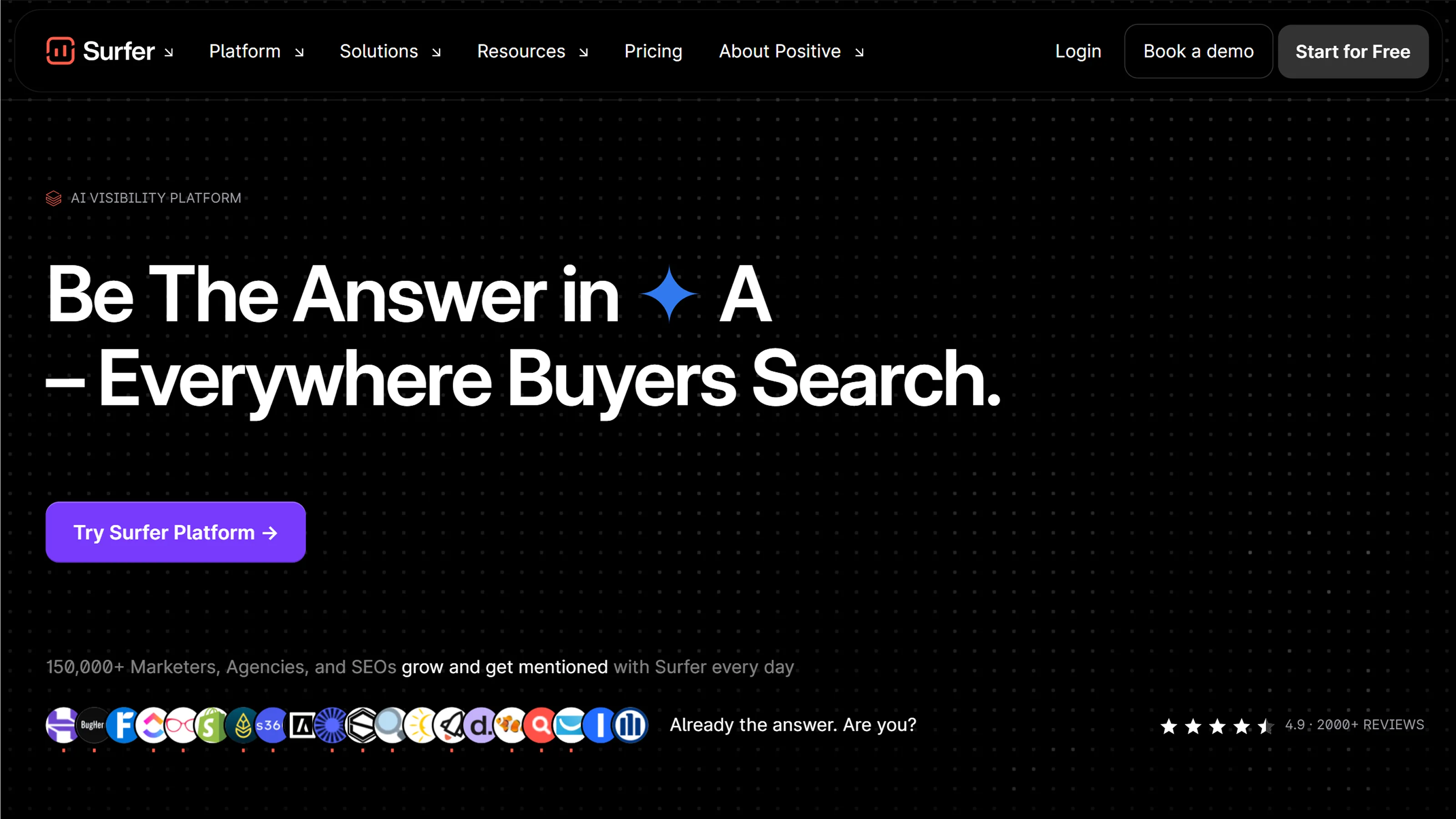
Its Content Editor scores drafts in real time against top-ranking pages for a target keyword, surfacing NLP-based term recommendations, heading structure, and word count targets as you write.
Surfer also runs a Topical Map feature for planning content clusters, a Content Audit that flags ranking drops and refresh opportunities, and an AI writing assistant called Surfy for drafting inside the editor.
Starting price: $59/month (Discovery plan). There's no forever-free tier, though Surfer offers free standalone tools like an AI detector and a Chrome extension.
Best for: Content teams publishing 10 to 40 articles per month who want a fast, workflow-integrated editor with AI visibility layered on top.
Pros:
- Real-time scoring inside Google Docs and WordPress
- AI visibility tracking is now bundled into paid plans instead of sitting behind a separate paywall
- Topical Map and Content Audit help plan and maintain content, not just optimize single drafts
Cons:
- Surfer's optimization logic is built around what already ranks on Google. For topics where AI answers draw from sources that don't rank traditionally, its recommendations can miss the mark entirely.
2. Botric
Botric is an AI visibility tracking platform built for growth teams that need to move from "are we cited?" to "what's causing the gap and how do we fix it?" It tracks prompt-level performance across ChatGPT, Gemini, Perplexity, and Claude separately, so you can see that your brand appears in 14 of 20 Gemini prompts but only 6 of 20 ChatGPT prompts for the same category.
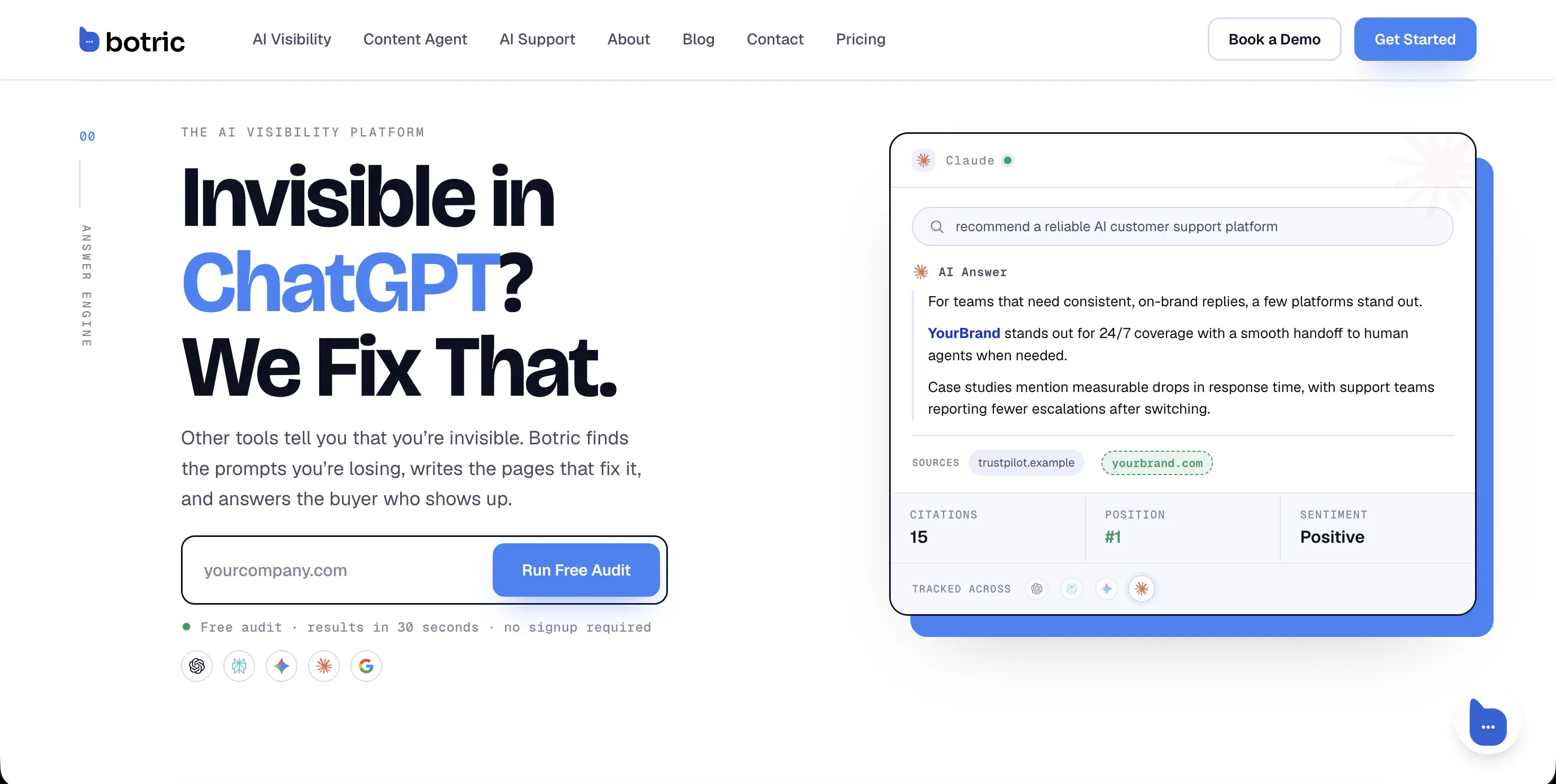
A blended visibility score can hide meaningful differences between AI engines. Per-engine reporting helps teams identify exactly where visibility is strongest and where additional optimization is needed.
Starting price: Free forever, with paid plans starting at $15/month (Bit plan). The free plan includes a Site & GEO audit, 4 blogs generation, and 5 tracked prompts on ChatGPT with no credit card required.
Content generation (AI blog output built for citations) is included starting on the entry paid plan, Bit, so you don't need to jump tiers to get optimization alongside tracking. Multi-engine coverage across all five platforms (including Claude and Gemini) requires the top self-serve tier, Infinity, at $149/month.
Best for: B2B SaaS companies, agencies, and growth-stage teams that want a single platform to track AI visibility, uncover content opportunities, optimize for AI search, and improve citations without a lengthy enterprise procurement process.
Pros:
- Per-engine tracking, not blended scores, across five AI platforms
- Free plan available with no credit card required
- AI blog generation included from the cheapest paid tier, not gated to the top plan
Cons:
- Smaller historical citation dataset than more established enterprise platforms.
For context on how Botric compares to Profound specifically, the Botric vs. Profound comparison walks through the trade-offs directly.
3. Conductor
Conductor is the tool in this roundup that tries to be one integrated platform across content creation, traditional SEO intelligence, and AI search tracking.
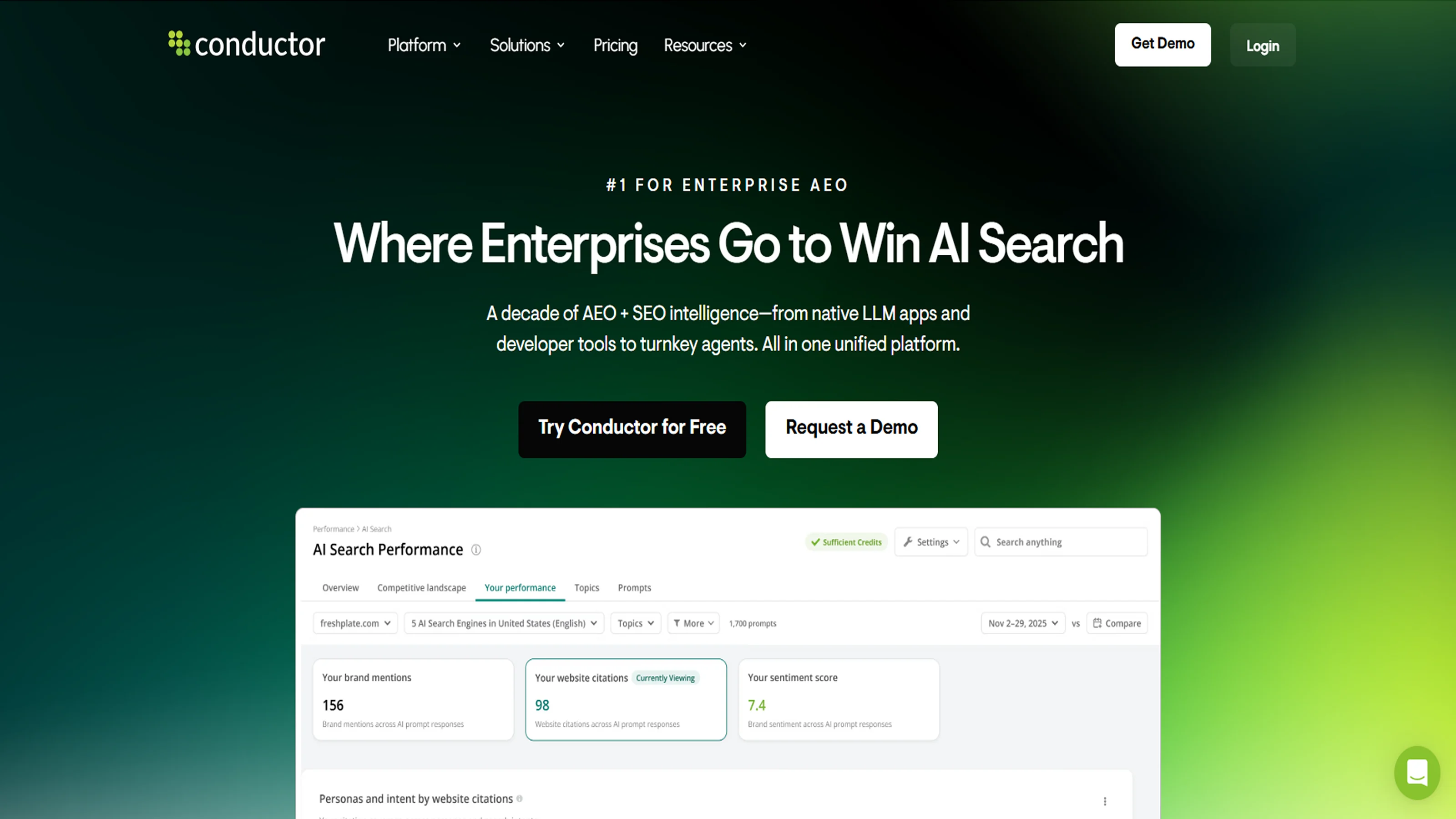
It combines Conductor Creator for AI-assisted content drafting, keyword and competitive research covering billions of search terms, and Conductor AI visibility monitoring across ChatGPT, Perplexity, Google AI Overviews, and Gemini in a single enterprise suite.
Starting price: Custom pricing (no public pricing). You can try it free for 3 weeks without a credit card.
Best for: Enterprise SEO and content teams that want a single platform covering the full lifecycle from keyword research to AI citation tracking, and have the budget to match.
Pros:
- Unified dashboard for traditional SEO, content, and AI visibility
- Tracks brand citations across ChatGPT, Perplexity, Google AI Overviews, and Gemini
Cons:
- No self-serve pricing; all quotes require a sales conversation
- Steep learning curve for teams new to enterprise SEO platforms
4. Clearscope
Clearscope grades your content using NLP analysis of top-ranking competitors and query fan-out data, then tells you which terms and topics to add to close the gap. Beyond the text editor, it includes brand visibility tracking across ChatGPT and Gemini, AI draft generation, and internal linking suggestions.
Its unlimited-user pricing model is the standout: every plan covers your whole team with no per-seat charges, which matters when several writers and editors need access to the same reports.
Starting price: $129/month (Essentials plan). There's no forever-free tier, but Clearscope offers a 14-day free trial.
Best for: Enterprise editorial teams and agencies with established content workflows who need consistent quality at scale.
Pros:
- Unlimited users on every plan, no per-seat cost
- 14-day free trial
- Query fan-out awareness gives writers a genuinely different lens than standard keyword research, showing the underlying searches AI platforms trigger to build their answers.
Cons:
- Clearscope's report model is metered by prompts, pages, and drafts. Teams that refresh old content often or test multiple content angles can burn through their Essentials allocation quickly, and add-on costs add up.
5. Profound
Profound is a dedicated AI visibility intelligence platform built for mid-market and enterprise brand teams. Its Answer Engine Insights feature shows how a brand and its competitors appear across AI platforms, tracking citations, sentiment, ranking, and competitive presence.
Prompt Volumes adds a demand signal for what people are actually asking AI engines in a given category, and Profound Agents let teams run automated content and optimization workflows on a credit-based system.
Starting price: $99/month (Starter plan). No free plan is available. A paid plan is required to access the dashboard.
Best for: Enterprise brand and SEO teams that need structured, stakeholder-ready AI visibility reporting across multiple regions.
Pros:
- Deep multi-platform tracking with prompt-level analytics
- Prompt Volumes surfaces AI search demand data most competitors don't show
- Strong competitive benchmarking against named rivals
Cons:
- Starter is ChatGPT-only; broader engine coverage starts at Growth
- Prompt limits can feel restrictive at lower tiers
- Profound's citation database is strong for monitoring, but the platform doesn't close the loop into content production. You'll still need a separate tool to act on what you find.
6. Scrunch AI
Scrunch AI was acquired by Sitecore in June 2026, and the platform now operates as Scrunch, a Sitecore company, feeding its AI visibility data into Sitecore's broader digital experience platform.
It's still sold and used as a standalone AI visibility tool, with one feature few competitors match: dedicated crawler and agent-traffic analytics that show how AI bots actually access and use a site, on top of standard citation and mention tracking, sentiment analysis, and competitor benchmarking.
Starting price: $250/month (Core plan). There's no free plan, though a 7-day trial is available on entry-level access.
Best for: Brands in regulated industries where AI-generated misinformation is a real compliance risk, and agencies managing multiple client workspaces.
Pros:
- Genuinely strong crawler and agent-traffic analytics, rare in this category
- SOC 2 Type II certified
- GA4-connected AI referral traffic tracking
Cons:
- Claude tracking and the full Agent Experience Platform are Enterprise-only
- Core plan's price is high relative to the 4 engines it covers
Should You Pick One Tool or Build a Stack That Covers Both Jobs?
The right choice isn't about finding the platform with the longest feature list. It's about deciding whether your team benefits more from an integrated workflow or a combination of specialized tools.
Team size, publishing volume, reporting requirements, and budget all influence that decision.
When a single integrated platform makes sense
If you'd rather manage everything from one platform, both Botric and Conductor aim to combine AI visibility tracking with content optimization, but they're built for different audiences.
Conductor is designed for large enterprise SEO teams that need traditional SEO, content workflows, and AI visibility reporting in a single platform. If you have a dedicated content team, multiple stakeholders, and enterprise reporting requirements, its unified suite can be a good fit.
Botric takes a more execution-focused approach. Instead of only showing AI visibility metrics, it connects prompt-level tracking with GEO audits, competitor analysis, content gap detection, and AI-powered content generation, making it easier for growth teams to move from identifying a visibility gap to publishing optimized content without switching tools.
When a best-of-breed stack beats a single tool
For most teams, the better move is pairing one optimization tool with one visibility tracker. A content lead who uses Surfer SEO for drafting and Botric for post-publish tracking has a tighter, more agile workflow than one waiting for an enterprise platform to be configured.
| Scenario | Recommended Stack | Why |
|---|---|---|
| Solo creator / small team | Botric Bit | A free GEO audit, AI content generation, and AI visibility tracking make it a practical starting point for teams that don't need a dedicated content optimization platform yet. |
| Growth-stage B2B SaaS | Surfer SEO + Botric Byte | Surfer streamlines content optimization before publishing, while Botric tracks AI citations, identifies content gaps, and monitors visibility across multiple AI platforms after publishing. |
| Marketing team scaling content | Botric Infinity | Combines multi-engine AI visibility tracking with GEO audits, competitor analysis, AI-powered content optimization, and AI content generation in a single workflow. |
| Mid-market with advanced editorial workflows | Clearscope + Botric Infinity | Clearscope strengthens enterprise content optimization, while Botric provides detailed AI visibility tracking, GEO audits, and actionable recommendations to improve AI citations. |
| Large enterprise SEO program | Conductor | Best suited for organizations that want traditional SEO, content operations, and AI visibility reporting in a single enterprise platform with centralized governance. |
| Enterprise / regulated industry | Clearscope + Scrunch AI Enterprise | Designed for organizations that prioritize compliance, AI crawler analytics, and enterprise governance alongside large-scale editorial workflows. |
The mistake most teams make is buying an optimization tool, publishing better content, and assuming the visibility problem is solved.
Optimization and visibility tracking are related but separate jobs, and skipping the second means flying blind on whether any of it is working in AI answers. For a full breakdown of how generative engine optimization works as a discipline, that's the right place to start.
Conclusion
AI content optimization and AI visibility tracking solve different parts of the same problem. Optimization tools help you create content that's easier for search engines and AI models to understand, while visibility platforms measure whether that content is actually being cited in AI-generated answers.
The best choice depends on your team's goals. If your priority is producing higher-quality content, a dedicated optimization platform may be enough. If you also want to understand how your brand performs across ChatGPT, Gemini, Claude, Perplexity, and other AI search platforms, you'll need visibility tracking as well.
For most teams, the strongest GEO strategy combines both. Create content based on real opportunities, publish with confidence, and continuously measure how AI search engines respond so every update is backed by data rather than assumptions.
Key Takeaways
-
AI content optimization improves content before publishing, while AI visibility tracking measures how often your brand is cited after publication.
-
Ranking well on Google no longer guarantees visibility in AI-generated answers, making AI citation tracking an important part of modern SEO.
-
Most platforms specialize in either optimization or visibility tracking, while platforms like Botric combine AI visibility monitoring with GEO audits, content recommendations, and AI-powered content generation in a single workflow.
-
Enterprise teams may prefer integrated platforms, while growth teams often benefit from flexible, self-serve tools that combine optimization with continuous AI visibility tracking.
-
The best GEO results come from treating optimization and visibility as an ongoing cycle: identify opportunities, improve content, measure AI citations, and repeat.
Want to know whether AI platforms actually recommend your brand? Run a free GEO audit with Botric to measure your visibility across ChatGPT, Gemini, Perplexity, Claude, and other leading AI search platforms.
Discover where you're being cited, uncover content gaps, benchmark competitors, and turn AI visibility insights into actionable improvements from a single platform.
Frequently Asked Questions
Do I need both an optimization tool and a visibility tracker?
Yes, if AI citation performance matters to your team. Optimization tools improve content before publishing; visibility trackers confirm whether AI engines are actually citing it afterward. The half you're missing is increasingly where buyer discovery happens.
Does ranking #1 on Google guarantee AI visibility?
No. Ranking highly on Google improves your chances of being cited, but it doesn't guarantee visibility in AI-generated answers. AI platforms evaluate additional signals such as topical authority, entity coverage, content completeness, freshness, and how directly a page answers a user's question. That's why some lower-ranking pages are cited while higher-ranking pages are not.
Can a traditional SEO tool like Semrush or Ahrefs replace a dedicated AI visibility tracker?
Not completely. Traditional SEO platforms are excellent for keyword research, rankings, backlinks, and technical SEO, and some now include AI visibility reports. However, dedicated AI visibility platforms go further by running prompts across AI search engines, measuring brand mentions and citations, tracking competitors, and identifying content gaps based on real AI-generated responses.
Which tools have a free tier or trial?
Among the tools in this comparison:
- Botric offers a free forever plan that includes a GEO audit and limited AI visibility tracking, with paid plans starting at $15/month.
- Surfer SEO does not offer a free plan, but it provides free standalone tools and a money-back guarantee on paid subscriptions.
- Conductor offers a 3-week free trial with no credit card required.
- Clearscope offers a 14-day free trial but no free plan.
- Scrunch AI offers a 7-day free trial on its Core plan.
- Profound does not offer a free plan, but paid plans start at $99/month.
If you're evaluating AI visibility for the first time, starting with a free plan or trial is a practical way to understand your current AI search performance before committing to a paid platform.
How often should I check AI visibility?
For most teams, checking AI visibility weekly is a good baseline. AI models, search indexes, and competitor content change frequently, which can affect citations even if your rankings stay the same. Continuous monitoring helps you spot visibility gains or losses early and prioritize content updates based on real AI search performance.
What's the difference between Profound and Botric for AI visibility tracking?
Both platforms help brands measure AI visibility, but they're designed for different audiences. Profound focuses on enterprise reporting, competitive intelligence, and stakeholder dashboards for larger organizations. Botric is built for growth teams that want to combine AI visibility tracking with GEO audits, competitor analysis, content recommendations, and AI-powered content generation in a self-serve workflow.